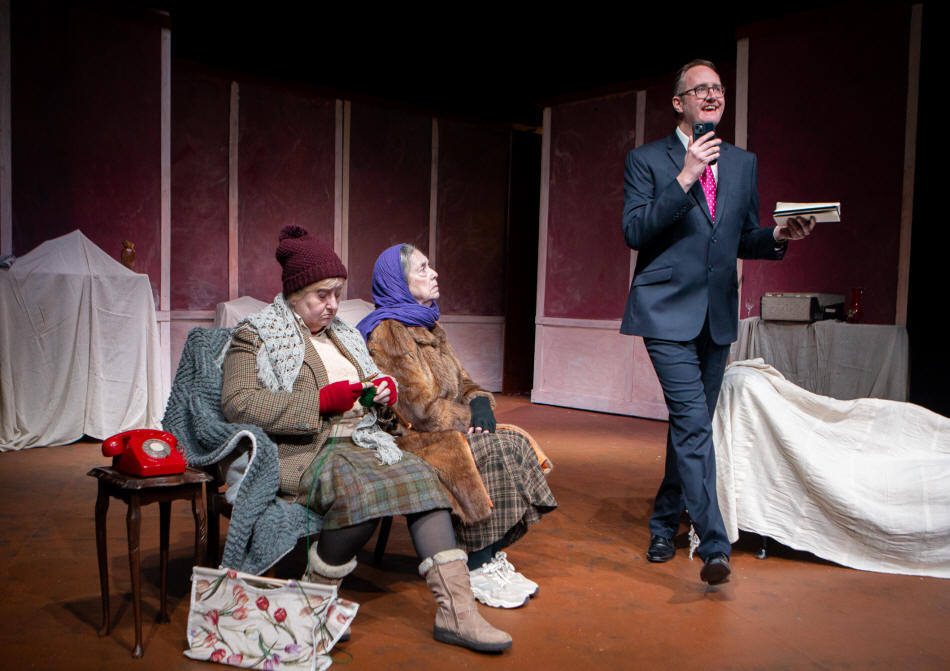
Maggie Lane as Iris, left, Sandra Haynes as Dorothy and Simon Findlay
as Bevan
People
Highbury Theatre Centre
*****
Old age can be marketed as history,
decrepit as characterful, broken as quirky, all to be monetarised and
sold to the people as heritage when seen through Alan Bennett's
observant eyes.
We open in the peeling grandeur of Stacpoole
House, stately home of South Yorkshire aristocracy with a fortune built
first on sheep then coal then . . . past glories and triumphs don’t pay
today's bills and times is hard.
Which brings us to Bennett's observations on the
way forward for the stately pile. Lady Dorothy Stacpoole, once a
celebrated model, lives in the run-down decaying mansion with her
companion, Iris.
The house has endless treasures, a roomful of
chamber pots . . . don’t ask . . . all. . . well just there and still
there because, well . . . that's what they have always been, just there.
There is no hot water, the central heating doesn't work, the front door
won't open and coal collapses regularly in the mine workings under the
house.
Dorothy abhors the very idea of her home being
opened to the public to pay the bills and even considers a shady deal to
sell to a shadowy consortium who would move the house to Dorset or
Wiltshire, somewhere warmer, although not as handy for Sheffield as Iris
points out.
It is a wonderful performance from Sandra Haynes
as Dorothy who just wants herself, Iris and their home to be left alone.
Carrying on a life with no hot water, no heating, no money for repairs
or simple maintenance and, most of all, no people seeing her and her
beloved if careworn home as an exhibit was her first choice, but, sadly,
nostalgia was never going to be a viable option.
Iris, played with a genial grumpiness by Maggie
Lane, is happily knitting comforters for the troops – we should mention
we are in 2012 here, not WW1 – and drifting along with the flow,
throwing in some waspish comments and put downers along the way. She
seems to be the only one with common sense and does not seem too
bothered what happens, as long as she can continue to live there with
Dorothy without too much disruption – a sort of preserved in a moment of
time, as in now, option.
She really does not like interference from
Dorothy's sister. June, played by Annie Moseley. June is the Archdeacon
of Huddersfield and she wants to donate the house to the National Trust
who would maintain it and preserve it.
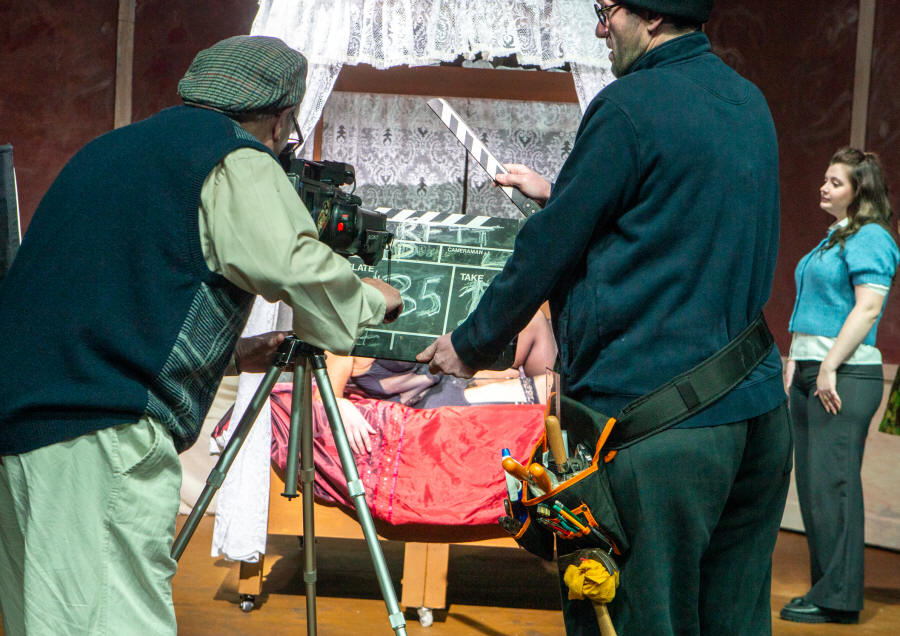
Clever blocking leaves us admiring the
more technical aspects of the ins and outs of film making
To this end she has introduced Ralph Lumsden,
played by Martin Walker, a senior rep from the National Trust, to assess
the property. He is full of views on heritage and public access, and the
place of mundane, or eclectic objects in telling THE story or at least
his version of it.
Bennett uses June and Ralph to have a gentle, but
pointed, dig at both the CofE and the NT for their similarities in both
attitude, thinking and membership – there if you notice.
To balance Lumsden, Dorothy has oh so smooth
auctioneer Bevan, played by Simon Findlay. Bevan is playing a two hander
with all the charm and persuasion of an up market double glazing
salesman. Option one is sell up for a shedload of cash, or sell the
house to some secret group called The Concern who would move the house
to Wiltshire or Dorset and . . . Dorothy and Iris would live in the
lodge with ensuites and hot water while the house would be . . . we
never got round to that.
So now enter Mr Theodore, played by Garry Cooper,
who was a tea boy in Dorothy's modelling days but is now a film producer
and director and provides a third option, paying to use the house and
its four poster beds as a film location, a sort of saviour in celluloid,
or more silicon in these SD card days.
Theo's films are not likely to find their way to
the local Odeon, being more at home in those back street establishments
with blacked out windows no one wants to be seem entering or leaving or
mail order promising discrete packaging.
But when you are broke, £5,000 for providing a
location is on offer, beggars can't afford to be choosers, so lights,
camera, action.
That brings in Colin, who we could describe as a
rising star. . . eventually . . . and his sort of laid back Finnish
co-star, Brit played by Alex Hunter, along with a film crew of lights,
sound, camera, director, make up, wardrobe (the budget didn't seem to
run to costumes).
Grips, clappers, focus pullers - enter Bruce,
(Richard Constable), Louise, (Lucy Johnson), Nigel, (Kelvin McArdle) and
Les (Ron Parker) and a gold star here for the blocking from director
Phil Astle.
While Colin and Brit were . . . demonstrating
horizontal aerobics, the positioning of reflectors, film crew and extras
Dorothy and Iris was simply brilliant, with not even a glimpse of flesh
on view behind them even when June turned up with The Bishop, played by
David Weller
With all options on the table Dorothy and June
had to reach a decision before the house fell down, a decision that
would change life for Dorothy and Iris whatever it was and ensuring a
sadness in the final scene as Dorothy's safe if dilapidated world is
lost for ever.
The play is one of Bennett's later works, (2012)
and perhaps is more comedy than earlier classics with less delving into
depth of character and more a dismantling of a heritage culture whether
stately homes or the Church, exposing the commodifying of life.
Not that you have to travel that path too far to
enjoy what is a witty, Bennett comedy, beautifully acted with excellent
pace on a convincing set from Malcolm Robertshaw with lighting design
from Steve Bowyer and sound design from Richard Irons all adding to the
story. Ably directed by Phil Astle, the home's future will be on the line to 07-02-26.
Roger Clarke
28-01-26
Highbury
Theatre Centre
|