|
|
|
|
|
|
Stars explained: * A production of no real merit
with failings in all areas. ** A production showing evidence of not
enough time or effort, or even talent, and which never breathes any real
life into the piece – or a show lumbered with a terrible script. *** A
good enjoyable show which might have some small flaws but has largely
achieved what it set out to do.**** An excellent show which shows a
great deal of work and stage craft with no noticeable or major
flaws.***** A four star show which has found that extra bit of magic
which lifts theatre to another plane. |
|
|
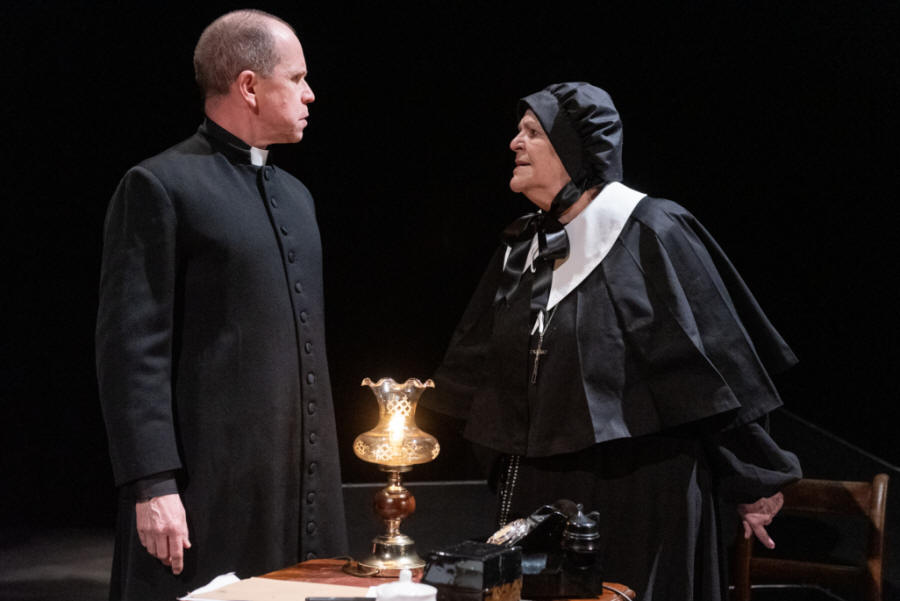
Doubt The Loft Theatre Leamington Spa ***** Doubt, suspicion, distrust, presumption, assumption, speculation, surmising. Doubt is the Loft’s latest addition to its own splendidly thought-out season. The title might seem curious to those unfamiliar with the incredibly sinister high grossing film starring Meryl Streep and the late Philip Seymour Hoffman: but it focuses on a deeply disturbing battle of wits on its two main characters: a priest, and a nun. Doubt: a Parable started life as a stage play by the affable and insightful John Patrick Shenley. Shenley has penned some 25 or more plays. This was in 2004; the film, which he also directed came in 2008. High flown Awards came thick and fast, most notably a Tony for the play and a Pulitzer Prize for the film. He had already picked up an Oscar in his talented, youthful thirties, as early as 1987, for his screenplay for the film Moonstruck. There are areas of rather slow development in the first half which I must admit gave me doubts. Yet the Loft fielded an utterly inspired quartet of actors, including Artistic Director Sue Moore in the main role of Sister Aloysius, who continually asserts ‘I know’ whenever any other character (there are just four) questions her judgment, her opinion or her slightest qualm is virtually treason. ‘I have my certainty’. Head of a large secondary school (St. Nicholas), for all her claim to be steered by ‘the rules’, she is a harridan and a bully. If she were less of an obnoxious browbeater, if the students and staff weren’t all intimidated and terrorized by her, one could deploy all sorts of unpleasant terms to describe her. Can we believe that her name, in Greek, means ‘unwashed’? But why ‘Doubt’? The play – I have to say its whole demeanour reminded me strongly of The Crucible - is centred, perhaps in not quite enough detail, on something very air today, but is in some small degree ahead of its time, on Sister Aloysius forming the not just tenuous but determined assumption that a priest – Father Brendan Flynn (Michael Barker) – has, to use one phrase, ‘interfered’ or made advances’ with a 12 year old black boy (I think, puzzlingly, the only one in the school. Perhaps in a certain year). The whole play unfolds around Aloysius’s increasingly untenable view – fact inferred from doubt – that this abuse has indeed happened, and she makes it her task to squeeze a confession and unmask the accused, or mis-accused, abuser. Father Flynn, as it happens, is preaching at the start, coincidentally, about this very thing: ‘What do you do when you’re not sure?’ Their mutual antipathy which surely occasions the presumption and most likely (if not provenly) unjustified assertions is clear from early on, where the priest comments ‘You stand there like a parking meter’. She has her own take: ‘He’s after the boy.’ ‘There are parameters that protect him and hinder me.’ Hindrance is what she needs. And just what she hasn’t got. She can rule the college; and lay down laws as she chooses.
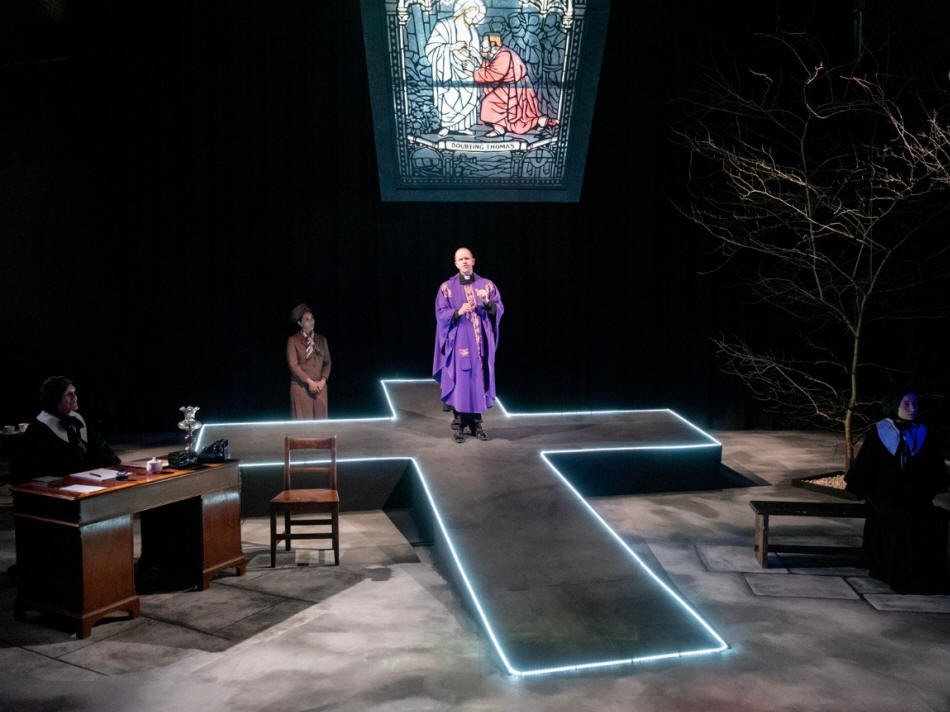
But more on the performance; the story being essentially just that. The massive brightly lit cross which dominates the stage (Richard Moore) with a wonderfully atmospheric stained glass window drives home the essential fact that what is possibly being abused here is not what is claimed, but religion itself – here Catholic. The moves in Chris Gilbey-Smith’s production are actually rather limited because of this, which limits. Its most striking and effective moment is actually at the close, when Sue Moore, suddenly spiritually troubled and, one feels, wonderfully stirred internally, indicates she has – yes – doubt. She has made the uncharacteristic, occasional allowance, previously (‘but maybe it’s nothing….’). Curiously there’s virtually only one joke in the whole (‘Not that there’s anything wrong with sugar’). Another thing that impressed was the skill Director and cast managed to generate not overstressed or exaggerated American accents, but mild and restrained ones. It suited the production remarkably well, and Father Flynn’s Irish background showed through too. This was strikingly competent, and it worked really well.. It's the scene at the start, between two nuns, that sets the ball rolling so effectively. The shy young nun, Sister James (Anna Butcher), almost a novice, who inadvertently draws attention to the possible issue, is played with such delicacy and respect, purity and touching innocence, she creates the most exquisite of the four performances. Her technique is astonishing – the little flutters of her head, her shoulders, her facial flitters. This was a wonderful performance. There are only two big rows in the play. One, naturally, is Barker’s affronted, self-defending priest and Sue Moore’s almost vilely insistent Mother Superior. The other is when Sister James suddenly flares up – even explodes - with indignation: my, we didn’t expect that, and how strongly it impacts here at the Loft. Father Flynn, who is enthusiastic and appealing even when faced with these cancerous threats, fights his corner as best he can against his intractable opponent. ‘I’m not the disciplinarian you are, Sister’. ‘Next time you are troubled with such dark ideas I suggest you discuss them with the Monsignor.’ ‘She’s like a block of ice (and Sue Moore provides us with just that).‘ Father Flynn, you have a history’. Does he, or has she made it up? Like the opening between Sue and Anna, the late arrival – summoned – of the boy’s mother produced one of the most polished scenes. Again, an absolutely splendidly judged performance from Nadine Batchelor-Hunt. She is the mother. She can know, or infer, things about her son that are no business of this gavelling, intrusive headmistress. Even when Aloysius throws in ‘It’s not about what the child may be, it’s about the man’ she (Mrs. Muller) is unfazed. Is the pursuit and defrocking of Flynn what it’s really about, not his relation to her son? The Loft is as spectacularly skillful at presenting plays with small casts (Pinter, Miller) as it is with large ensembles: Chekhov often; last season’s Spring Awakening (also Gilbey-Smith); the latest Animal Farm. As a company it is always exploring, questing, innovating, involving. It’s what any company should be, but time and again it stands out among the others. This superbly calibrated quartet was a classic example of its undiminished excellence. Such quality; such polish, such intelligence. Time and again, first-rate. To 07-03-26 Roderic Dunnett 02-26 |
|
|
|