Stars explained: * A production of no real merit
with failings in all areas. ** A production showing evidence of not
enough time or effort, or even talent, and which never breathes any real
life into the piece – or a show lumbered with a terrible script. *** A
good enjoyable show which might have some small flaws but has largely
achieved what it set out to do.**** An excellent show which shows a
great deal of work and stage craft with no noticeable or major
flaws.***** A four star show which has found that extra bit of magic
which lifts theatre to another plane. Half stars fall between the ratings
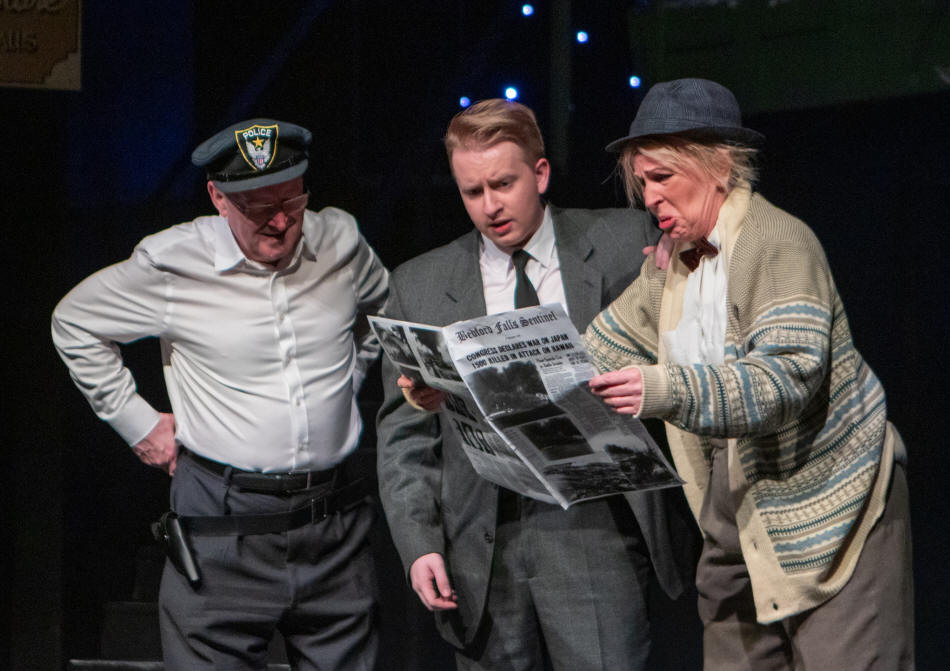
Ken Agnew as Bert, Nick Room as George and Pippa
Olliver as Uncle Billy.
Pictures: Alastair Barnsley
It's A Wonderful Life
Highbury Theatre Centre
*****
What a sparkling Christmas cracker of a
show to melt away winter's gloom as we head into the festive season.
This adaptation of the 1946 James Stewart classic
remains steadfastly true to the original to create an exceptional piece
of theatre from what is essentially a cast of four.
We are in small town America, and it is Christmas
Eve, 1946. Bedford Falls is a place where everyone knows everyone -
weddings, christenings, funerals . . . same crowd celebrating or
commiserating every time. We meet George Bailey, the dreamer with dreams
that fate and circumstance keep just out of reach. Then we have Bert,
the town's policeman, Mr Potter, the rich, anything for a profit,
heartless villain of the township and the piece, and then there is Mr
Gower, the sad and troubled owner of the drug store.
Then we have George's brother Harry and his wife,
and George's best friend Sam, oh and George's wife Mary and his Uncle
Billy, and Mr Martini who runs the bar, and did we mention the angels,
three of them? Well two really, proper angels that is, as Clarissa is
only a sort of apprentice angel, still to be awarded her wings.
George's father Peter and uncle, Billy, had
started Bailey Brother's Trust and Loan, a sort of credit union,
providing low cost homes to allow the less well-off to save and own
their own homes – Potter, incidentally, being the foil to that, a
slumlord offering high rent, low quality housing to the desperate. The
Trust and Loan made no one rich, certainly not the brothers, but
enriched the community it served.
Nick Room, on his debut at Highbury, is a superb
and convincing George, always believable in what is an emotional part
that could run away with a less accomplished actor - we really do feel
for him and the cards fate insists on dealing to him.
Which leaves us with Ken Agnew, Pippa Olliver and
Kate Pilling to play . . . well most of the population of Bedford Falls,
and what a brilliant job they manage.
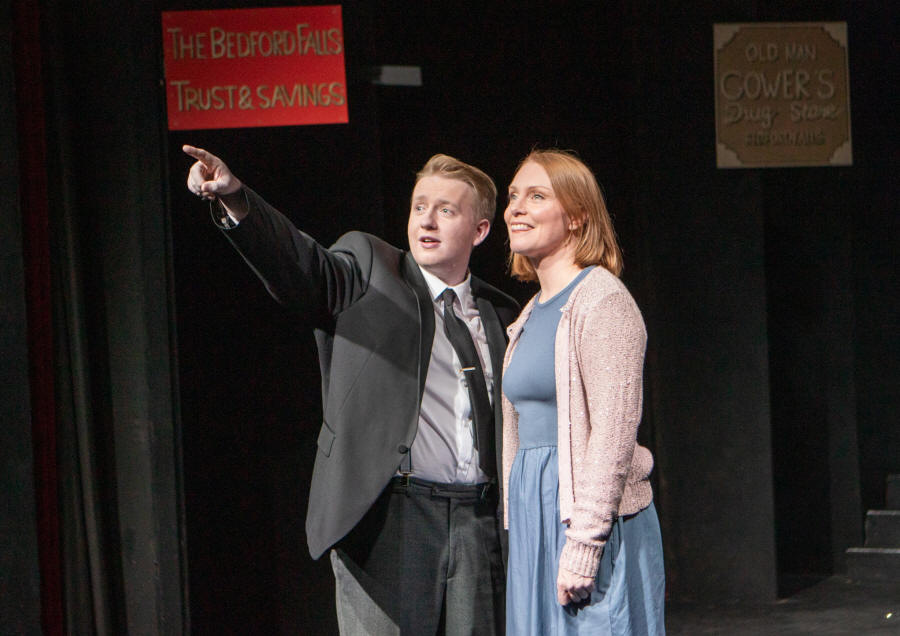
Nick Room as George and Kate Pilling as
his wife to be, Mary Hatch
We open with the trio as angels and Kate Pilling
as Clarissa, rather than the film's Clarence, hoping to earn her wings
with her newly assigned task of returning to earth and saving George –
with an hour to accomplish it . . . which is a bit of a push as she has
find out everything there is to find about him and contend with a 20
minute interval . . .
She also has to be all the other ladies in
George's life, his wife Mary and Harry's wife Ruth, and do all the angel
stuff and she manages to separate them all quite beautifully, which is
not easy with women of much the same age and much the same costume give
or take a few accessories. George's life has become a mess, not of his
own making we must add, and Kate's Mary and Clarissa, are the two women
who help him make sense of it all.
Ken Agnew has it a bit easier with men of
different ages and dispositions, but he still manages to give them all
their own individual characterisations from the heartless Potter to the
grief-stricken Gower, beat cop Bert and the young flying ace Harry among
others.
While Pippa Olliver had it all a bit harder, for
a start she had to contend with touch of cross casting turning up as the
somewhat ancient Uncle Billy, exuberant best friend Sam and Signore
Martini, owner of the local bar. She managed to keep all her characters
distinct, full of life and fun with Billy's wobbly walk one to savour.
It is an exceptional performance by the quartet
to populate the stage with a township utilising just four actors, but,
to be honest, good as they were, and they were good, even they might
struggle to create crowd scenes – such as a run on the bank for example,
when two characters are effectively the bank and one is an angel which
doesn't leave much left for a crowd so there are moments when eight
additional cast join in - enter concerned residents of Bedford Falls,
production manager and continuity Nicki White, deputy stage manager
Nathan McNaught, assistant stage manager Amy McDonald, and stage crew
Richard Clarke, Dave Douglas, Andrew Leigh-Dugmore, Ron Parker and front
of house manager Maggie Lane.
Life has a habit of throwing problems at George
which he manages to solve, but at a cost. The one problem he can never
solve is his own, the dreams and hopes he never quite manages to reach
and come 1946 and his Christmas is far from a merry one, so he is left
wishing he had never been born. The moral here is simply, be careful
what you wish for . . . especially if there is an eager beaver angel
around . . . just saying.
The result is a very human story, touching and
heartwarming, that riches and fame are measured not by bank accounts,
big houses and flash cars with the final benediction: "Remember, no man
is a failure who has friends".
Malcolm Robertshaw's set is a clever affair with
a raised platform for heaven and the fateful bridge, with a starlit sky
behind and roll on offices and drug store while Mike Lloyd and Logan
Mytton add to the atmosphere with some precise lighting.
Mary Elliott Nelson's adaptation has been around
since 2016 and is a lovely piece of theatre, paying homage to a
Christmas classic and Rob Phillip's light touch, capable direction
brings what is now a 79 year old story to . . . well, to wonderful life.
To 13-12-25.